성평등가족부 영문사이트

이 누리집은 대한민국 공식 전자정부 누리집입니다.

go.kr 주소를 사용하는 누리집은 대한민국 정부기관이 관리하는 누리집입니다.
이밖에 or.kr 또는 .kr등 다른 도메인 주소를 사용하고 있다면 아래 URL에서 도메인 주소를 확인해 보세요
| Government to cope with population decline by strengthening childcare and through promotion of women economic activities/respect for family diversity | |||
|---|---|---|---|
| Name | 운영자 | Date | 2021-07-26 |
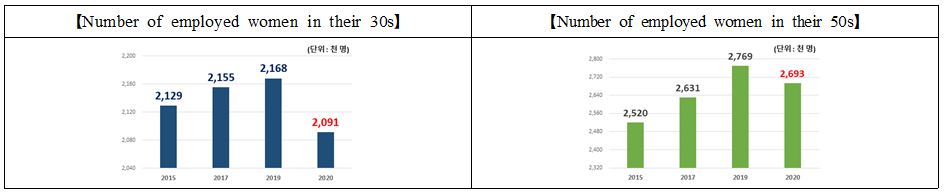
Government to cope with population decline by strengthening childcare and through promotion of women economic activities/respect for family diversity - MOGEF announces measures suggested by the 'Pan-government 3rd round Population Policy TF - Women Employment/Family Policy Team' - 『(Measures suggested by the 3rd round Population Policy TF) Expansion of women’s employment and provision of support for all families’ life in stability』 ◉ Expansion of vocational education/training related to promising careers or high added value (2,800 women in 175 occupations) ◉ Provision of more tax reduction for businesses hiring women experiencing career interruptions (Period recognized as career interruptions shortened from 3 years to 2 years) ◉ Development of social economic organization models including housework; coming up with framework for analysis of status of gender equality at businesses and government institutions ◉ Lengthening childcare institutions’ operating hours (in the morning/evening/weekend) ◉ Provision of stronger support (including psychological support) for young married couples’ (under 24) childcare ◉ Promotion of new support for building a one-person household life cycle-related social network; status survey of lonely death cases; formation of basic plan The Ministry of Gender Equality and Family (MOGEF/Minister Chung Young-ai) organized a team working on the 'maintenance of women’s career/mitigation of career interruption, diverse types of families, and measures against reduction in the number of family members' with those from eleven related ministries including the Ministry of Education (MOE) and Ministry of Employment and Labor (MOEL), which report to the Pan-Government Population Policy TF (headed by the 1st Vice Minister of Economy and Finance). It came up with sub-tasks such as formation of a gender-equal labor market through maintenance/expansion of women’s employment and building of society wherein all families can live equally and announced them at the Ministerial Conference on Social Relations held on July 28. The country is witnessing a seriously low birth rate. Its Total Fertility Rate (TFR) stands at 0.84 (in 2020), and it is expected to see a decrease in labor supply due to the population decline.* Likewise, the percentage of women taking part in economic activities and the employment rate of women are way below the OECD average,** and the gap between women and men is large. * At the current rate, the country’s population is expected to decrease by about 12 million or 24.0% by 2067, which is the second fastest rate of decrease among the 29 countries whose population comes to more than 50 million (or the 17th fastest among 235 countries of the world). (Source: Statistics Korea (KOSTAT)) ** Women’s employment rate (2019): 57.7% vs OECD 61.3% Under the COVID-19 situation, the margin of decrease in the number of employed women is larger than that of employed men.* Especially, the number of employed women in their 30s and 50s has started to decrease. * (Number of employed among those aged 15 or more/in 2020) women: 11,523.000 (a 137,000 decrease from 2019)/ men: 15,381,000 (an 82,0000 decrease from 2019)
In skills/technology-intensive industrial sectors like science/technology or information technology (IT), the level of women’s participation remains low, including the percentage of women employed in such sectors and speed of increase in women employed in them.* This shows the prevalence of gender-based occupational segregation and glass ceiling in the labor market. * (2006 → 2019) Percentage of women employed: 30.77% → 37.38% / Percentage of women managers: 10.22% → 19.76% Amid the decrease in population, working married couples feel heavier burden in childbirth/care, which creates a vicious cycle through the deepening of low birth. Childcare service has expanded in consideration of such situation, but there is still a long way to go to meet married couples’ demand for flexible service hours or the like as part of childcare support and relevant service quality. It has also been pointed out that the current system still discriminates against diverse family types and lacks support for them even amid the changes in families (e.g., one-person household having become the mainstream household type, decrease in number of family members, family types having become diverse). * Changes in mainstream household types: four-member household (27%) (in 2005) → two-member household (24.6%) (in 2010) → one-member household (30.2%) (in 2019) Said measures were taken to be prepared for problems associated with population decline and structural changes in population more systematically on a mid/long-term basis. 1. Promotion of women’s participation in economic activities ▸ Providing women experiencing career interruptions with an opportunity for vocational education/training related to promising careers: 2,600 women in 164 sectors → 2,800 women in 175 sectors ▸ Increasing Tax reduction for businesses hiring women experiencing career interruptions (mitigation of period recognized as career interruptions shortened) ▸ Providing support such as career search/design and startup/employment designed to help young women wishing to make forays into natural sciences/engineering Providing positive support for women (including those experiencing career interruptions) seeking employment or startup, particularly those wishing to make forays into science/technology to cope with the decrease in labor supply. First, strengthen women’s vocational capability and provide positive support for women seeking jobs. Expansion of vocational education/training related to promising sectors such as IT, design, Big Data, etc. through the Centers for Women Restarting Their Business Career (2,600 women in 164 sectors in ’21 → 2,800 women in 175 sectors in ‘22) Increasing the number of ministries* taking part in programs for training women experiencing career interruptions as professionals and providing one-stop support for their employment; mitigation of conditions for tax reduction** for businesses hiring women experiencing career interruptions. * (In 2021) eight ministries [Ministry of Science and ICT (MSIT), Ministry of Trade, Industry and Energy (MOTIE), Ministry of Culture, Sports and Tourism (MCST), etc.] → (In 2022) addition of Ministry of Health and Welfare (MOHW), Korea Forest Service (KFS) ** Period of career interruption for women: 3 years or more (previously) → 2 years or more (currently) Second, helping women make forays into start-ups and future-oriented sector Provision of 2.5 trillion won worth of fund for the growth of women-run businesses until 2024; providing in-depth consulting, inviting successful women start-ups. Operation of customized integrated online platform (W-Bridge) designed to help women engaged in science/technology sectors throughout the entire life cycle from elementary school to retirement Strengthening support for young women interested in making forays into natural sciences/engineering (review of integrated support program development including career search/design and finding jobs/running start-up by 2022) 2. Creation of equal labor conditions ▸ Development of customized support models designed to provide counseling/consulting to women wishing to stay in their current jobs and concerning childcare ▸ Strengthening human rights protection/support for nurses and houseworkers ▸ Promotion for coming up with an integrated analysis framework concerning the gender equality status of businesses and government institutions Provision of support designed to help women stay employed; spread of work-life balance culture; putting an end to the gender gap in the labor market; arranging to have more women take part in diverse economic activities First, strengthening support designed to help women stay employed and spreading the work-life balance culture Development of customized support models for counseling/consulting/childcare designed to help women stay employed, particularly those engaged in science/technology sectors; promotion of pilot projects starting 2022. Coming up with detailed guidelines for a remedial procedure concerning the employer’s step taken regarding employee-related sexual discrimination/workplace sexual harassment to be adopted at the Labor Relations Commission to come into force in May 2022. “Causing serious social criticism” to be included in the reasons for disqualifying a business in family-friendly certification; strengthening reasons* for disqualifying from leisure-friendly certification * Violation of the 「Equal Employment Opportunity and Work-Family Balance Assistance Act」 in the past three years to be included in the disqualifying reasons Second, improvement of labor conditions in job sectors where women are the majority; mitigation of gender gap in the labor market Making a manual/operation of in-depth educational session for the protection of human rights of nurses, etc.; coming up with subordinate regulation in preparation for the enactment of the 「Houseworker Act」; effort for the improvement of working condition of houseworkers. Arrangement of inclusion of gender segregation-related items in businesses’ management disclosure; Promotion for coming up with an integrated analysis framework concerning the disclosure of gender equality status by 2022. 3. Mitigation of parents’ childcare burden ▸ Extension of Community Childcare Center’s operating hours; operation of After-School Academy for Youths even on weekend ▸ Expansion of childcare service during busy seasons in rural areas: children aged 2-5 → children aged 2 – second graders ▸ Expansion of all-day one-stop service; improvement of service content Expansion of child care service hours to mitigate married couples’ childcare burden; enhancement of service quality First, strengthening childcare support related to elementary schoolers through the extension of childcare operating hours and improvement of facilities, etc. Extension of Community Childcare Center’s operating hours; operation of local childcare centers/after-school academy for youths on weekend in a bid to strengthen childcare support for married couples 'Childcare service' provided at home to be extended to single-parent families, disabled children, young married couples, households feared to be experiencing child abuse, starting 2022. Expansion of 'childcare service during busy seasons' in rural areas: children aged 2-5 → children aged 2 – second graders Second, improvement of childcare facilities’ environment; making it possible to use childcare service more conveniently Improvement of childcare facilities’ environment including remodeling of dilapidated childcare spaces and local childcare centers’ facilities Making it possible to apply for childcare spaces in school and use of local childcare programs at Government 24’s 'all-day childcare one-stop service', starting 2022. Segmentation of childcare service by hours of the day/programs for better service. 4. Helping all families live more stably ▸ Making the “statement on the relation with the household head” optional at the time of family registration to prevent the disclosure of familial relations of remarried families ▸ Strengthening childcare support for young married couples and case management ▸ Provision of support for building a social network for one-person households at each stage of the life cycle; status survey of lonely deaths; formulation of basic plans Strengthening policy support in step with the diversification of family types with the increase of single-parent families, remarried families, one-person households First, putting an end to discrimination against diverse family types in daily life Making the “statement on the relation with the household head” optional at the time of family registration to prevent the disclosure of familial relations of remarried families * (Before) “a child of a stepfather/stepmother,” etc. → (After) “a child of the parent” as chosen by the reporter To come up with ways of improvement by 2022 by getting a grasp of the status* of immigrants married to Korean but currently not eligible for the allowance paid under the 「National Basic Living Security Act」 * (Before) Rights of beneficiary recognized exceptionally for those raising (bearing) a child or supporting a lineal ascendant as ones married to a Korean Strengthening childcare support for young married couples (under 24) who used to be subject to social prejudice and placed as welfare blind spots; management of psychological/mental support; promotion of case management Second, strengthening support in connection with the trend for individualization including an increase in the number of one-person households
Helping one-person households build social network with others to prevent their isolation, starting 2022; strengthening mental health-related consulting; status survey designed to prevent lonely deaths; formulation of basic plans Promotion of reshuffling of the relevant systems including raising the income level of those eligible for basic livelihood security in consideration of their income level, employment status, childcare requirements, etc. Provision of 243,000 houses for young people and 52,000 rental houses for seniors by 2025; strengthening customized housing service support for them “We have prepared these measures since January through consultation with the relevant ministries to come up with policies designed to cope with changes in the country’s population structure including decrease in labor supply, crisis in women’s employment, and emergence of diverse types of families,” said Minister Chung Young-ai, commenting on the matter. She added, “We at MOGEF will continue to improve them so that they may display effects noticeably and check the status of execution faithfully. We will also continue to strive to help women stay employed, enhance the quality of life of all families including one-person households, and mitigate the current low births by alleviating married couples’ childcare burden.” |
|||
| Prev | MOGEF checks the status of promotion of policy for women’s employment carried out by 17 cities/provinces |
|---|---|
| Next | We’ll remember the International Memorial Day for Japanese Military Comfort Women! |

 Small
Small Medium
 Large
Large Larger
 Largest
 Default