성평등가족부 영문사이트

이 누리집은 대한민국 공식 전자정부 누리집입니다.

go.kr 주소를 사용하는 누리집은 대한민국 정부기관이 관리하는 누리집입니다.
이밖에 or.kr 또는 .kr등 다른 도메인 주소를 사용하고 있다면 아래 URL에서 도메인 주소를 확인해 보세요
| Korea to strengthen cooperation with Sweden for gender equality | |||
|---|---|---|---|
| Name | 운영자 | Date | 2019-12-26 |
□ The Ministry of Gender Equality and Family (Minister Lee Jung-ok) concluded an MOU on December 18 with the Ministry of Employment of Sweden for cooperation and policy exchanges for the improvement of gender equality. □ The MOU is the second MOU signed by the Ministry of Gender Equality and Family with the department in charge of gender equality in Nordic countries following the conclusion of an MOU with Finland in June of this year. □ Sweden is implementing policies for gender equality with a secretary in charge of gender equality in the Ministry of Employment and improving gender equality by grasping the reality of inequality based on gender, ethnicity, etc. through the equality ombudsman system. □ Owing to the implementation of such policies for gender equality, childcare policies, etc., Sweden is making great achievements in women’s participation in economic activities as the No. 1 in the glass-ceiling index* among the 29 member nations of OECD.
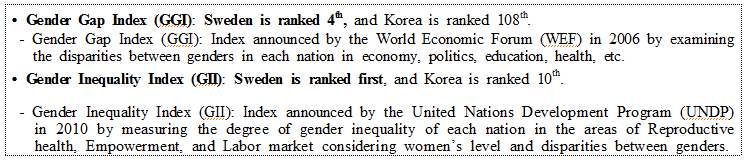
□ In particular, the year 2020 will mark the 25th anniversary of adoption of the Beijing Platform for Action (BPFA) and the 20th anniversary of adoption of UN Security Council Resolution No. 1325. The Ministry of Gender Equality and Family is also planning to implement various commemorative programs including hosting international conferences in order to publicize the results of implementation of policies for gender equality to the world. ◆ Comparison of the major statistics of Korea and Sweden in relation to gender equality◆ □ 2019 Gender Gap Index (GGI)
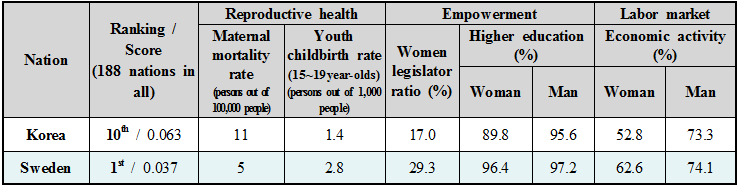
□ 2019 Gender Inequality Index (GII)
□ Status of advancement of women in political areas (IPU, as of Jan. 1, 2019)
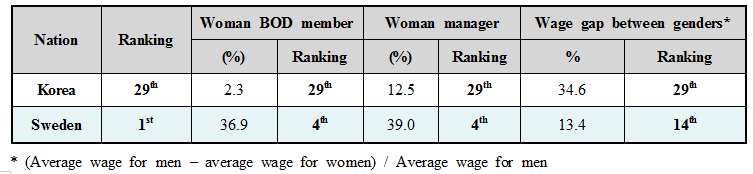
□ Glass-ceiling index (Economist, 2018)
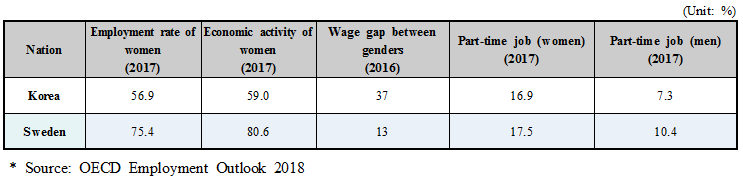
□ Economic activity, employment, and employment rate of women
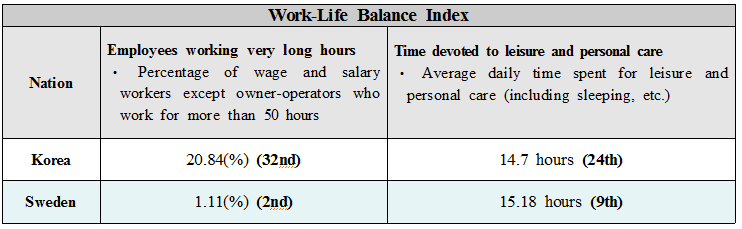
□ OECD Better Life Index (2017)
|
|||
| Prev | “2019 Gender Inequality Index and Gender Development Index” |
|---|---|
| Next | Women's Hotline and Youth Counseling Service Remain Open during Lunar New Year's Holidays |

 Small
Small Medium
 Large
Large Larger
 Largest
 Default